





Tbilisi, 28 September – 3 October 2026
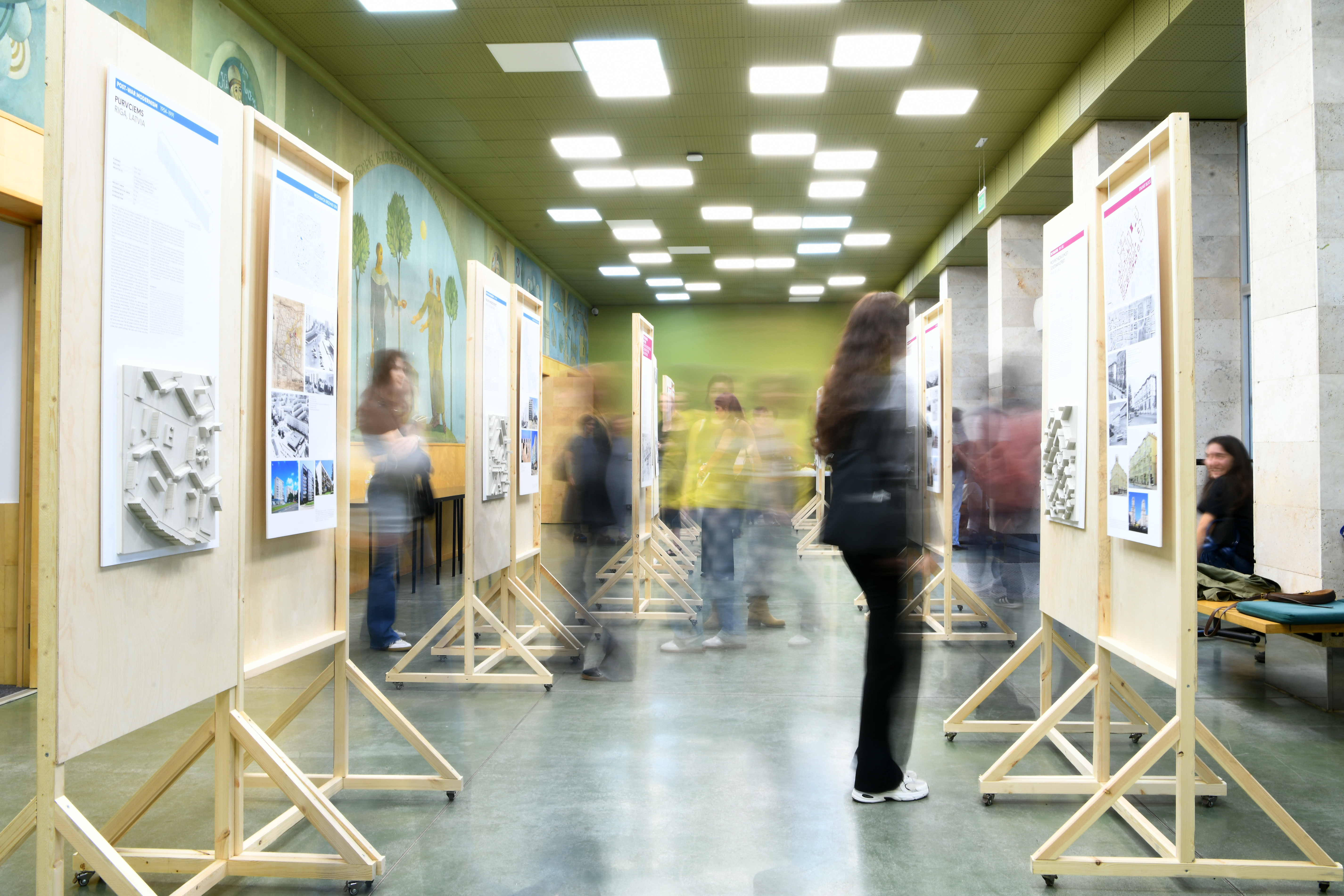
Photo by: Nika Abaishvili
From 28 September to 3 October 2026, the exhibition Residential Heritage: Soviet Morphotypes and Typologies was presented in the foyer of Building G at Ilia State University in Tbilisi. Developed by Subproject 3: Urban Spatial Transformations within the cities.building.culture research project, the exhibition formed a collateral event of the Tbilisi Architecture Biennial 2026, dedicated to the theme Geography of Emptiness.
The exhibition presented archival materials on Soviet residential morphotypes and typologies from Armenia, Belarus, Georgia, Kazakhstan, Latvia, Lithuania, Russia, Ukraine, and Uzbekistan. Ranging from early avant-garde experiments to standardised microrayons, the materials illustrated the diversity of residential environments produced during the Soviet period and their subsequent transformation over the past decades.
The Biennial’s theme Geography of Emptiness provided a framework for reflecting on this heritage from a contemporary perspective. Emptiness does not necessarily imply physical absence: buildings and neighbourhoods may remain inhabited while losing or transforming their original functions, meanings, and social connections. In this context, the exhibition addressed a central question of the cities.building.culture project: How can new meaning and new life be given to what is already there?
The exhibition was visited by members of Tbilisi’s architectural and academic communities, students, researchers, architects and participants of the Tbilisi Architecture Biennial. The local context was particularly relevant to the exhibition, as Tbilisi itself contains a diverse legacy of Soviet residential morphotypes and provides an important setting for discussing their preservation, adaptation, and future transformation.
The exhibition opened on 28 September with an introduction to the cities.building.culture project by Ekaterina Gladkova (Karlsruhe Institute of Technology), followed by the public lecture When Does Architecture Become Heritage? by cultural historian Polina Gundarina (University of Göttingen). The lecture explored how architecture comes to be recognised and valued as heritage, drawing repeatedly on examples of Soviet residential environments in Tbilisi. These local references resonated strongly with the audience and opened a discussion on the changing perception, transformation, and future of Soviet-era architecture in the city.
We would like to thank Ia Kupatadze and Nano Zazanashvili from Ilia State University, as well as the team of the Tbilisi Architecture Biennial, for their support and cooperation in organising the exhibition and accompanying programme.
The exhibition forms part of the cities.building.culture project’s ongoing research into the transformation and resilient development of Soviet-era residential heritage. This research continues in Tbilisi through the pilot study Transform for Resilience in the Vazha-Pshavela neighbourhood.