





Reflections from the Tbilisi Architecture Biennial 2026
by Ekaterina Gladkova, Marina Sapunova
A wooden table surrounded by chairs stands in a room with peeling ceilings and faded green walls. This is What the Wind Did Not Carry Away by Bakar Migriauli-Ghviniashvili, one of the works at the fifth Tbilisi Architecture Biennial, Geography of Emptiness (25 September – 3 October 2026). The empty table stands for a condition shaped by political turbulence, privatisation and migration, in which ‘the weight of social fabric preservation is delegated to independent initiatives only’ [1]. Yet it is also an invitation to sit down together.
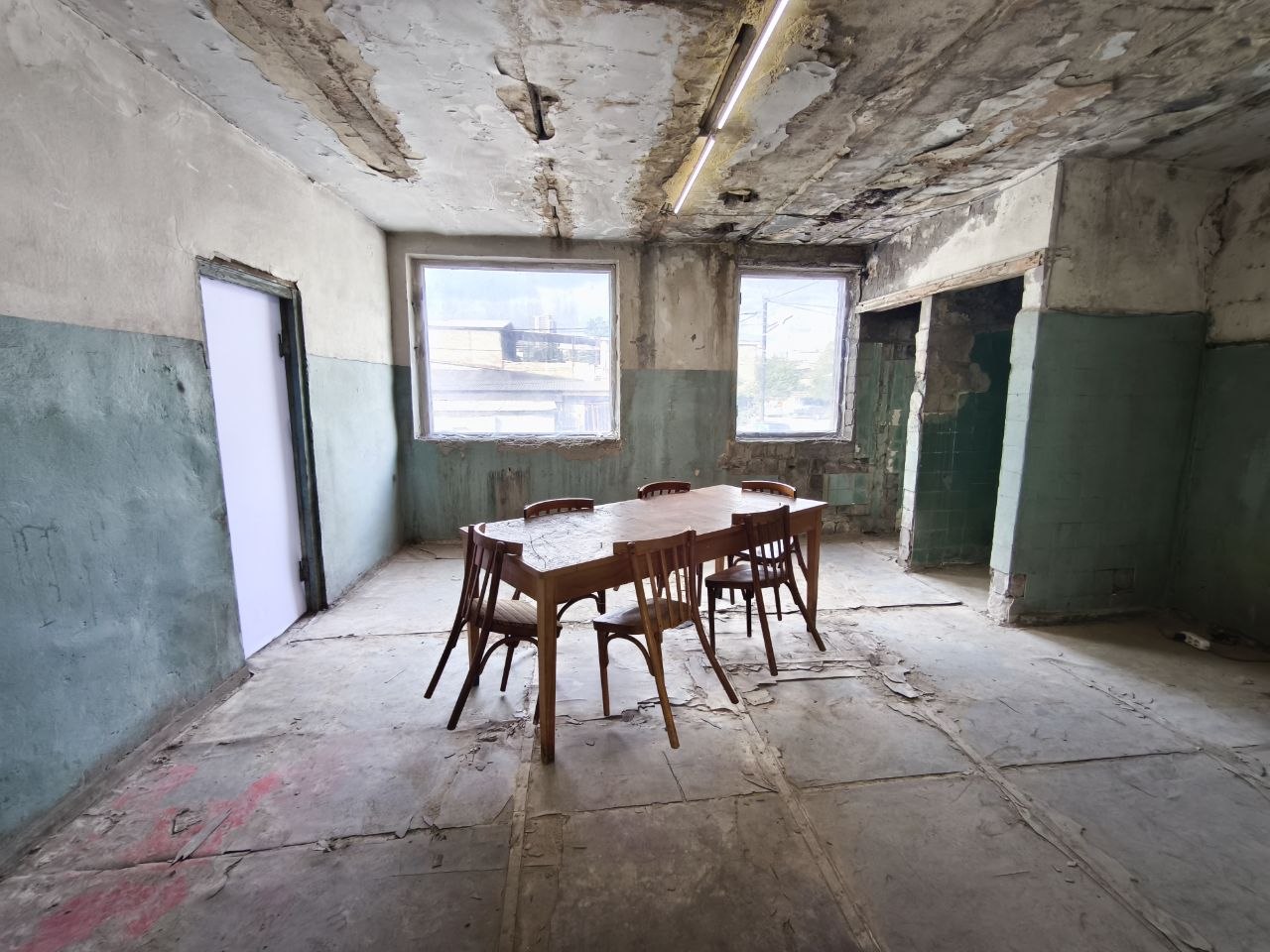
Pic.1 What the Wind Did Not Carry Away by Bakar Migriauli-Ghviniashvili (technical assistant: Sandro Sulaberidze). Open Space | Centre for Visual & Performing Arts, Tbilisi Architecture Biennial 2026. Photo: Ekaterina Gladkova.
The room itself is part of the statement. The Biennial took place at Open Space – Centre for Visual & Performing Arts, in the building of Saqelektromanqana, a factory built in 1962 that produced micro electric motors for plants across the Soviet Union. After the factory closed in the early 1990s, the building stood empty for more than two decades, until the club and art space Elektrowerk opened there in 2015 [2]. Spread over five floors of a building that has itself passed through emptiness, the exhibition lets visitors experience it before reading about it.
The curators sum up their approach in one line: emptiness is ‘a condition, not an absence’ [3]. In their statement, emptied places in the post-socialist world – abandoned villages, depopulated regions, half-built developments – are not the result of natural decline, but are produced by history and managed by politics. The Biennial traces several forms of this condition: regions emptied by the collapse of Soviet industry and collective farms, by labour migration, war and ecological disaster; cities where apartments become financial assets rather than homes; and a loss of local spatial knowledge, visible in the path from vernacular building through Soviet standardisation to post-Soviet ‘Eurorepair’.
The curators’ formula can also be read alongside a body of research that, since around 2020, has turned emptiness from a descriptive term into an analytical concept. In the ERC project Emptiness: Living Capitalism and Democracy After (Post)Socialism (University of Oxford, 2020–2025) [4], anthropologist Dace Dzenovska describes rural places in Latvia that gradually lose their constitutive elements: people, infrastructure, services, social networks and, ultimately, the future [5]. Other studies suggest that such emptiness rarely means the absence of people. Azra Hromadžić writes of ‘populated emptiness’ in an unfinished socialist retirement home in Bihać, which local officials described as empty while it was occupied by migrants and unemployed youth [6]. Lori Khatchadourian follows former workers and factory directors in Armenia who try to extract new value from the debris of Soviet industry [7]. In her study of a small town in northern Armenia, Maria Gunko describes a place ‘between disappearance and endurance’ [8]. Residents insist there is nothing there. Yet they keep the town habitable through constant repair.
The notion of endurance may offer a way into our own research. Subproject 3 of cities.building.culture, Urban Spatial Transformations, examines Soviet-era housing estates in the Baltics, the Caucasus and Ukraine, asking how post-1991 densification, privatisation and changing uses have affected their capacity to cope with crises. From this perspective, the curators' formula invites a further question: how resilient is the condition of emptiness itself? Resilience research has long recognised that systems may persist in undesirable states, absorbing shocks while reproducing themselves [9]. Emptiness may well be one such state. Once municipal maintenance and collective institutions have withdrawn, the resulting gap often persists. However, residents prove resilient too: they adapt, repair and negotiate within this gap. This dual nature of resilience – as the persistence of emptiness and as the capacity to live with it – runs through the neighbourhoods we study.
In Tbilisi, we explore this tension in the pilot study Transform for Resilience (2026–2027), conducted in the 1960s neighbourhood along Vazha-Pshavela Avenue in cooperation with Ilia State University and local partners. Unlike many of the places shown at the Biennial, these estates are rarely empty of people; many are, in fact, becoming denser. What has emptied out, in practice, are the institutions and routines that once maintained courtyards, greenery and shared infrastructure.
Of the more than thirty works, three seemed to us especially inspiring for thinking through this dual nature of resilience. Read together, they move across scales from single buildings, to former collective and state farms, to the edge of the city and offer three different readings of emptiness: as a persisting condition, as a space of uneven re-inhabitation, and as a productive state of possibility.
Post-Functional Emptiness: when buildings outlive their purpose
In this project, emptiness appears first of all as persistence. Developed by Natalia Nebieridze and Tata Gachechiladze of the Industrial Heritage Research Group, the exhibition draws on the 2024 research initiative Physical Mapping, which documented 1,390 post-functional buildings across 35 municipalities and ten regions of Georgia. A large photographic installation turned this dataset into a visual atlas, in which the repetition of abandoned structures is striking [Pic. 2]. For the authors, emptiness is both spatial and lived: it emerges when the connections between architecture, institutions and everyday life break down.
Physical Mapping, supported by the EU-funded Creative Compass Georgia programme and the Goethe-Institut Georgien, explores whether such buildings could serve the cultural and creative sectors. The Biennial's own venue is a case in point: a former Soviet factory that now houses a club and an art centre. Yet a single conversion says little about the 1,390 buildings in the dataset. Which of them might find new uses, and who will decide what those uses are, remains open. Khatchadourian calls such efforts to give old structures new value ‘trials of ruination’ – efforts that, as she shows, often run up against the limits of time, materials and capital [10].
For Soviet-era housing estates, the parallel is only partial: their buildings remain inhabited. Yet the authors' definition fits them well, since here, too, the connections between architecture, institutions and everyday life have been disrupted. Understanding their resilience therefore requires looking beyond the physical condition of buildings to the transformation of functions and everyday practices.
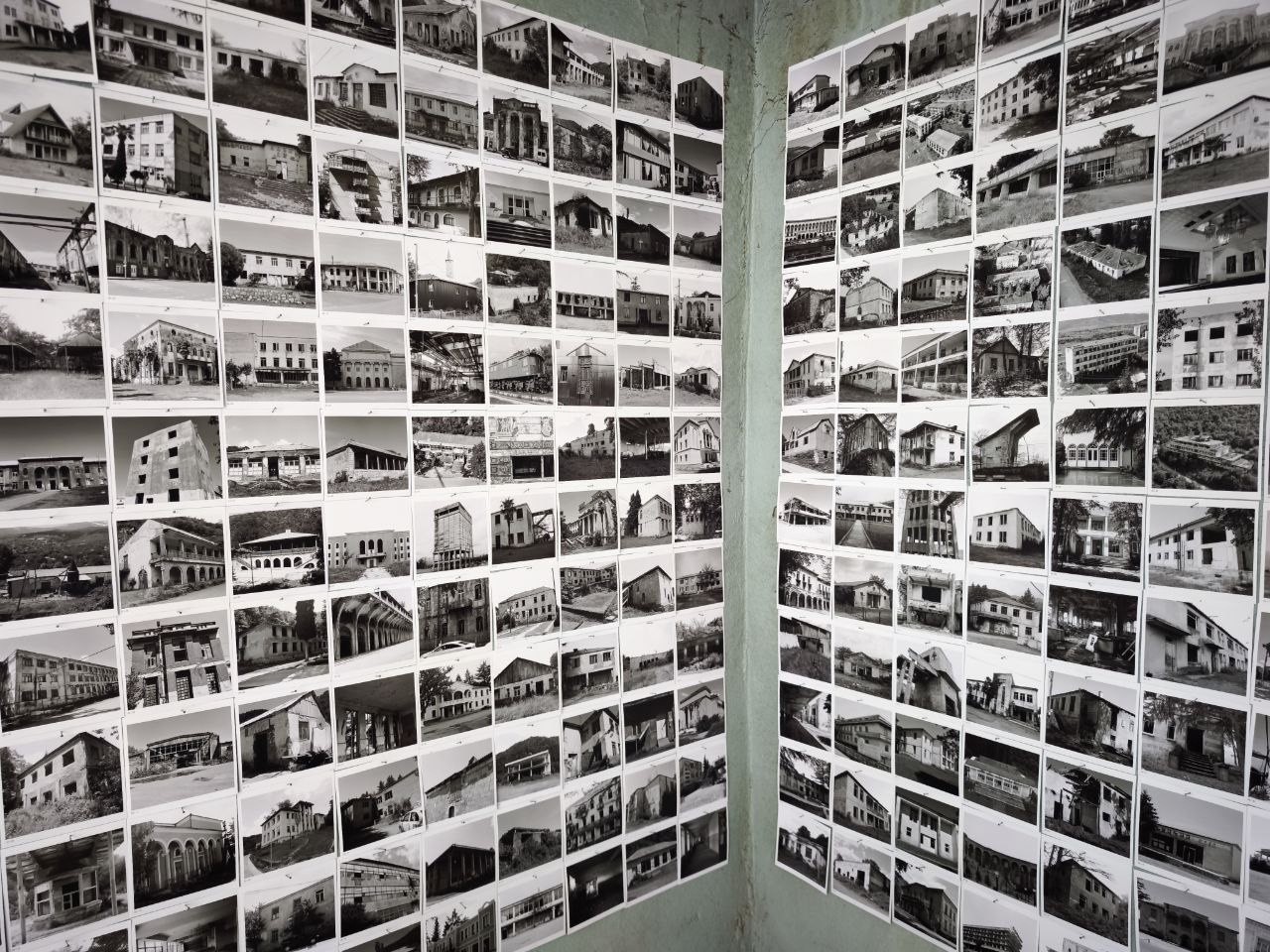
Pic. 2. Post-Functional Emptiness by Natalia Nebieridze and Tata Gachechiladze (Industrial Heritage Research Group): a photographic atlas of post-functional buildings across Georgia. Tbilisi Architecture Biennial 2026. Photo:Ekaterina Gladkova.
Meurneoba: living in structures without a system
Meurneoba: Futures of Yesterday explored the spatial legacy of Georgia’s former collective and state farms. Led since 2024 by Dimitri Eristavi, Lado Shonia and Jesse Vogler, with Klaus Neuburg, Moritz Winkler and Julian Knigge of Froh! e.V. and Ostfalia University of Applied Sciences, and developed through field schools with students, the project deliberately turns away from the prevailing urban narrative of Soviet modernism.
Each of these settlements was planned as a complex in which the farm was, at once, employer and provider of housing, infrastructure and services. In the 1990s, the collective and state farms were dissolved and much of their land was privatised. The farms disappeared. The houses, roads and service buildings they had built remained. Today these settlements are being re-inhabited by very different groups: people displaced by the wars of the early 1990s, new landowners who profited from the privatisation of land in the late 1990s and, most recently, the first climate refugees (in Georgia often called eco-migrants) resettled in these villages. Their arrival suggests a form of resilience. Yet the project describes the resulting landscape as one of uncertain inhabitation, in which belonging appears uneven – between those who acquired land and those who were placed on it [11].
Meurneoba takes the collective and state farms as a point of departure in their own right, not as the rural counterpart of Soviet urbanism. The project invites us to read these settlements on their own terms. Read side by side rather than against each other, the former state farm and the housing estate may show how differently the withdrawal of institutions is lived.
What’s Next? Transformation as Potential
A different perspective was offered by What’s Next? – The Edge of the City as a Space of Future Transformation, which examined Tbilisi’s urban periphery as a territory where infrastructure, informal occupation, natural systems, productive landscapes, and urban expansion overlap and continuously redefine one another. Developed by Daniel Lorenzo Almeida, Agata Buscemi, Pol Viladoms, Miquel Virgili, Angelica Pedrotti and LoCa Studio, the project included a workshop with the Design Institute in Tbilisi on 20–24 September, whose results were shown in the exhibition. Through territorial observation, audiovisual documentation and situated narratives, the authors assemble an open archive of territories in transition [12].
Of the three projects, What’s Next? offers perhaps the most optimistic reading: emptiness here is not absence but a productive state, a field of tension and possibility. Arguably, this reading carries a risk. Describing land as empty or open has often preceded its enclosure by private developers, producing the half-built developments that the curators count among today’s forms of emptiness. However, the project’s reliance on situated narratives suggests that the edge is already inhabited, used and negotiated, and that its future is not a blank page.
For our research, the edge has a historical echo. Between the 1960s and the late 1980s, Soviet housing estates were themselves built on the outskirts of cities, Tbilisi included. Today’s edge may thus become tomorrow’s inherited neighbourhood. The question of who decides its future may thus already be on the table.
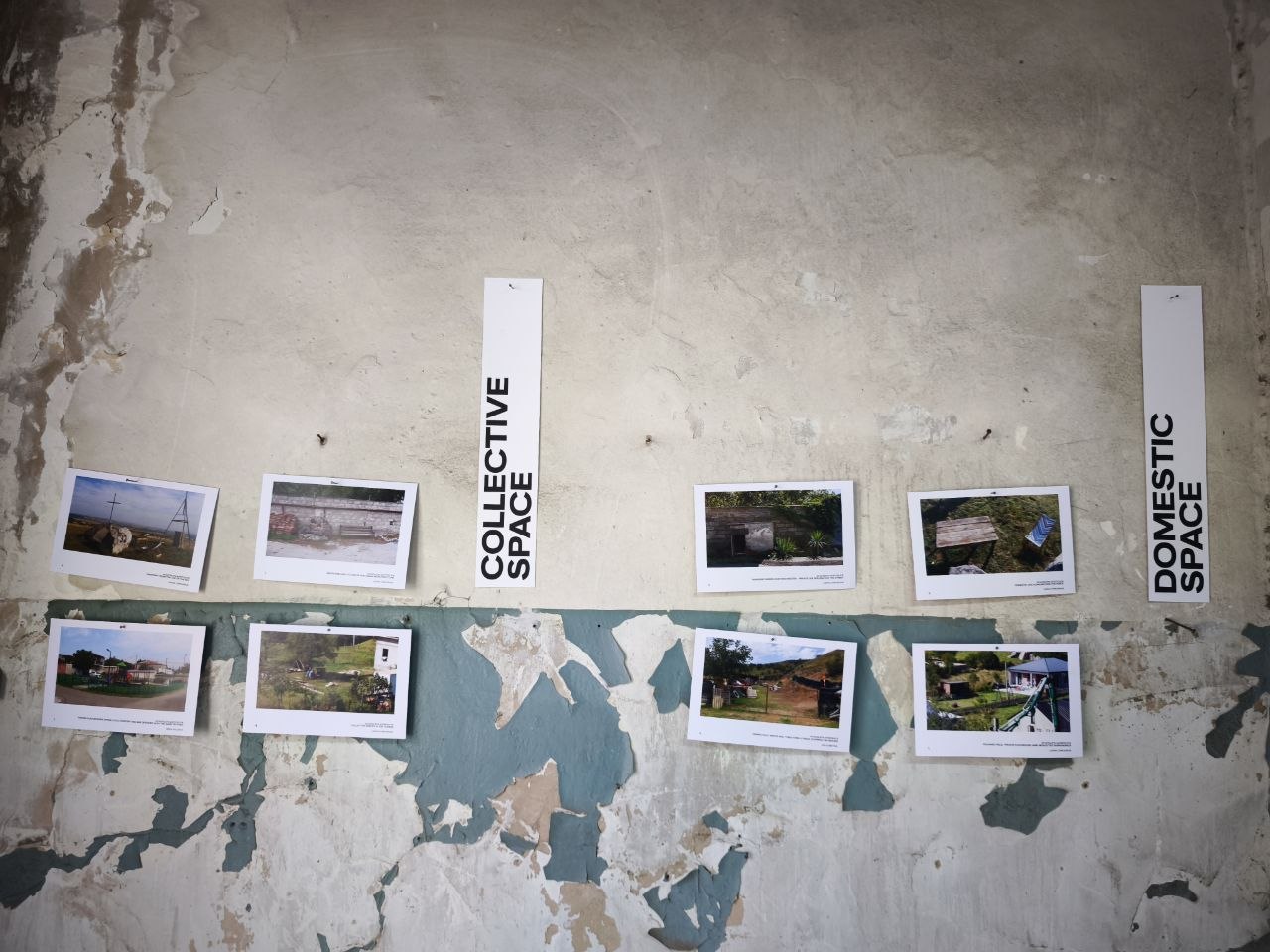
Pic. 3. What's Next? – The Edge of the City as a Space of Future Transformation: collective and domestic spaces at the edge of Tbilisi. Tbilisi Architecture Biennial 2026. Photo: EKaterina Gladkova.
Who Sits at the Table?
The empty table at the start of the exhibition was also an invitation. In the main hall, where the symposium and public talks took place, another object seemed to answer it. A long banner carried the founding manifesto of the Professional Union of Georgian Architects and Urbanists, calling for stable employment, paid internships, health insurance and, above all, organised collective action [Pic. 4]. Between the table and the manifesto, one might read a shared response to emptiness: where institutions withdraw, people organise themselves – residents in their courtyards, initiatives in abandoned buildings, professionals in their own field.
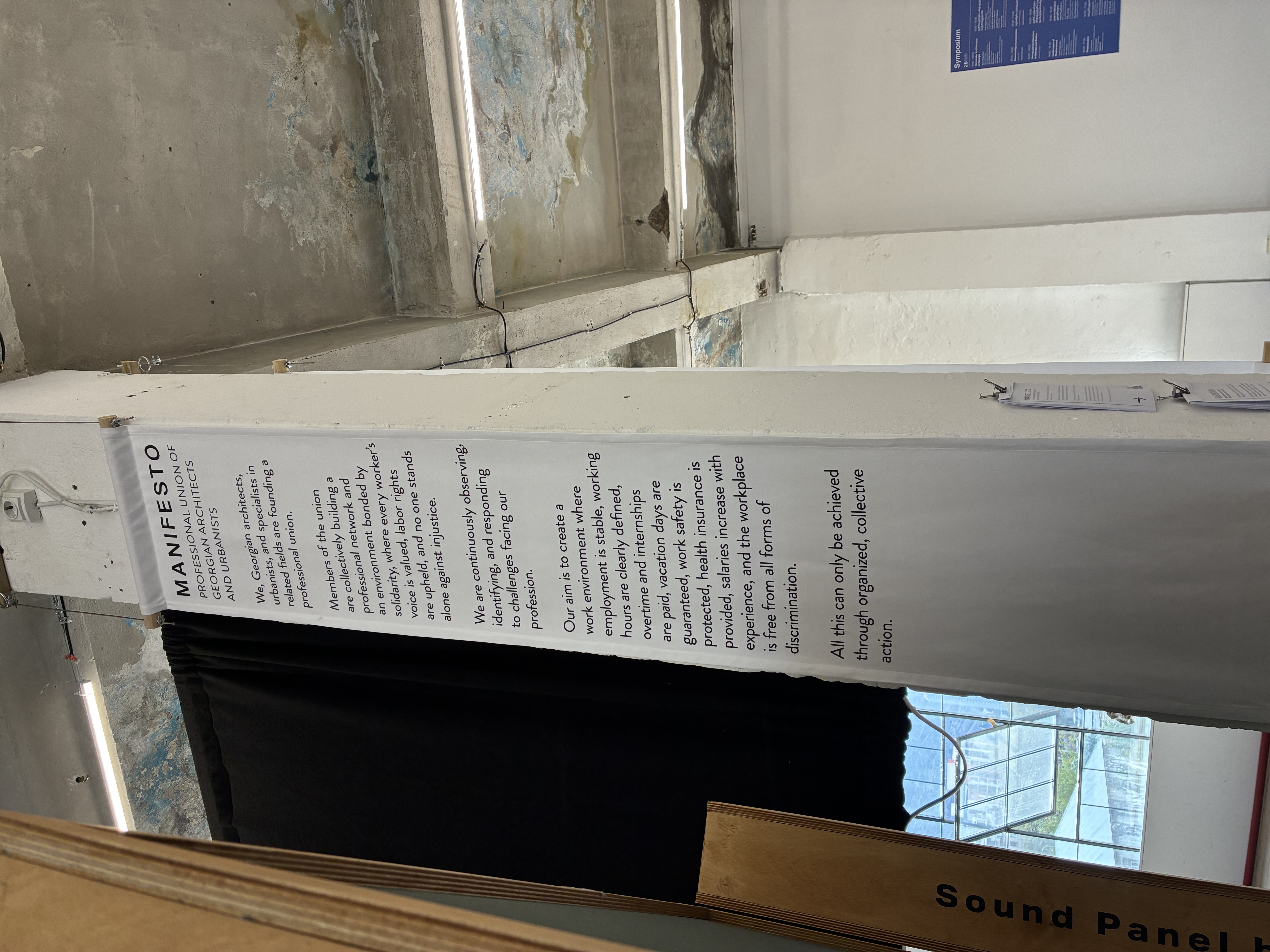
Pic. 4 Founding manifesto of the Professional Union of Georgian Architects and Urbanists in the main hall of the Biennial. Photo: Marina Sapunova.
This response, however, has a dual nature. Self-organisation is a form of resilience, and it often makes life within emptied structures possible. Yet the same endurance may also stabilise the condition it works against. When residents water the trees, repair the benches and negotiate the use of their courtyard, the gap left by municipal maintenance becomes less visible and easier to leave unaddressed. Critics of resilience thinking have warned that it can shift responsibility from institutions to those who have to cope [13]. The table’s text names this shift directly: the preservation of the social fabric is left to independent initiatives alone. Resilience, in this sense, can work in both directions.
The Biennial sharpened several questions that we now carry into our work in the Vazha-Pshavela neighbourhood. When does the endurance of residents turn emptiness into a permanent condition, and when can it become a starting point for transformation? Who carries the cost of maintaining what institutions have left behind? And who decides on the future of inherited places: residents, homeowners’ associations, municipalities or investors? These questions highlight the complex relationship between everyday practices, institutional responsibility, and the potential for collective transformation of inherited urban spaces.
Tbilisi Architecture Biennale 2026 — The Geography of Emptiness
References:
- Bakar Migriauli-Ghviniashvili, What the Wind Did Not Carry Away, exhibition text, Tbilisi Architecture Biennial 2026, Open Space | Centre for Visual & Performing Arts, Tbilisi
- Marketer.ge, ‘Industrial heritage turned into music: Elektrowerk’s art space in Tbilisi’ (in Georgian), 8 February 2018, https://www.marketer.ge/elektrowerk-music-events-tbilisi1/
- Tbilisi Architecture Biennial, The Geography of Emptiness: Programme 2026 (Tbilisi, 2026), https://cms.biennial.ge/storage/programme/554/tab_2026_programme.pdf
- COMPAS, University of Oxford, ‘Emptiness: Living Capitalism and Democracy After (Post)Socialism’ (ERC project, 2020–2025), https://www.compas.ox.ac.uk/project/emptiness-living-capitalism-and-democracy-after-postsocialism
- Dace Dzenovska, ‘Emptiness: Capitalism without People in the Latvian Countryside’, American Ethnologist 47, no. 1 (2020): 10–26, https://doi.org/10.1111/amet.12867
- Azra Hromadžić, ‘Populated Emptiness’, Fieldsights – Theorizing the Contemporary, Cultural Anthropology, 15 December 2020, https://www.culanth.org/fieldsights/populated-emptiness
- Lori Khatchadourian, ‘Life Extempore: Trials of Ruination in the Twilight Zone of Soviet Industry’, Cultural Anthropology 37, no. 2 (2022): 317–348, https://doi.org/10.14506/ca37.2.10
- Maria Gunko, Nothing there. A small Armenian town between disappearance and endurance. Social & Cultural Geography, 1–19. 2025 https://doi.org/10.1080/14649365.2025.2483712
- C. S. Holling, ‘Resilience and Stability of Ecological Systems’, Annual Review of Ecology and Systematics 4 (1973): 1–23; Brian Walker et al., ‘Resilience, Adaptability and Transformability in Social–Ecological Systems’, Ecology and Society 9, no. 2 (2004): 5.
- Lori Khatchadourian, ‘Life Extempore: Trials of Ruination in the Twilight Zone of Soviet Industry’, Cultural Anthropology 37, no. 2 (2022): 317–348, https://doi.org/10.14506/ca37.2.10
- Tbilisi Architecture Biennial, ‘Meurneoba: Futures of Yesterday’, https://www.biennial.ge/programme/meurneoba-futures-of-yesterday; Project Website https://futuresofyesterday.org
- Tbilisi Architecture Biennial, ‘What’s Next? – The Edge of the City as a Space of Future Transformation’, https://www.biennial.ge/programme/whats-next-the-edge-of-the-city-as-a-space-of-future-transformation
- Danny MacKinnon and Kate Driscoll Derickson, ‘From Resilience to Resourcefulness: A Critique of Resilience Policy and Activism’, Progress in Human Geography 37, no. 2 (2013): 253–270, https://doi.org/10.1177/0309132512454775