





Living with an Unfinished Post-Earthquake Landscape in Gyumri, Armenia
by Elena Batunova
As you travel northwest from Gyumri toward Marmashen, the city's continuous urban fabric gradually dissolves into a landscape that feels difficult to classify. At the end of May, the fields turn green, wildflowers grow along the roadside, and the snow-capped Mount Aragats appears in the distance. The view is beautiful, but unfinished and decaying concrete buildings break up the scenery. Some are just empty frames, while others still house a few people. Around them, you see dug-up pits, piles of rubble, broken roads, and large patches of disturbed land.
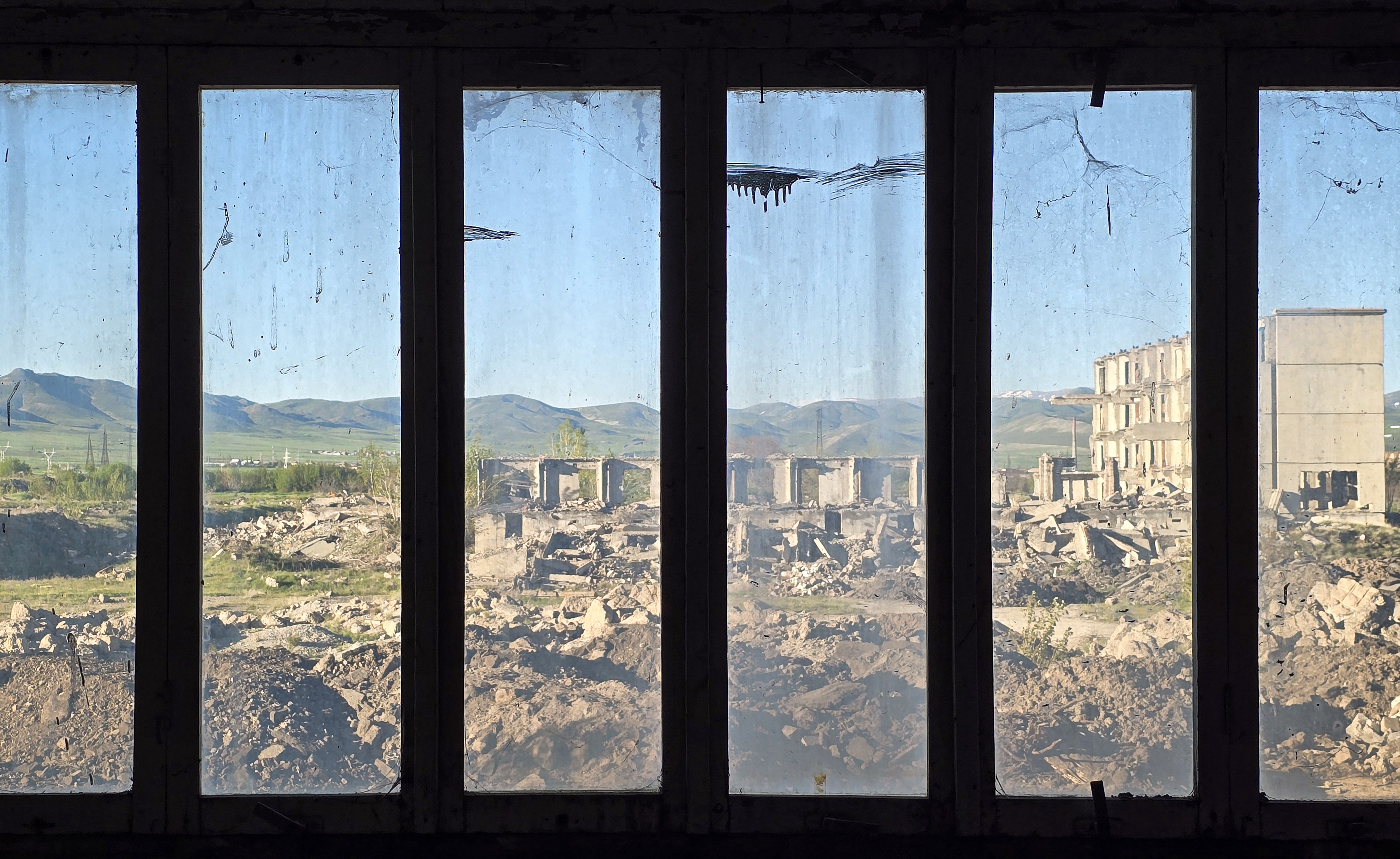
View from an unused apartment overlooking the remains of unfinished post-earthquake development on the northwestern outskirts of Gyumri.
What stays with you most is the scale. The ruins do not appear as isolated structures scattered across the landscape. They stretch across the horizon. As you continue driving, new clusters of unfinished buildings come into view long before the previous ones disappear. Excavated ground, abandoned construction sites and fragments of infrastructure repeat themselves again and again. The landscape gives the impression of a project that once expanded far beyond the limits of what you can see from any single location.
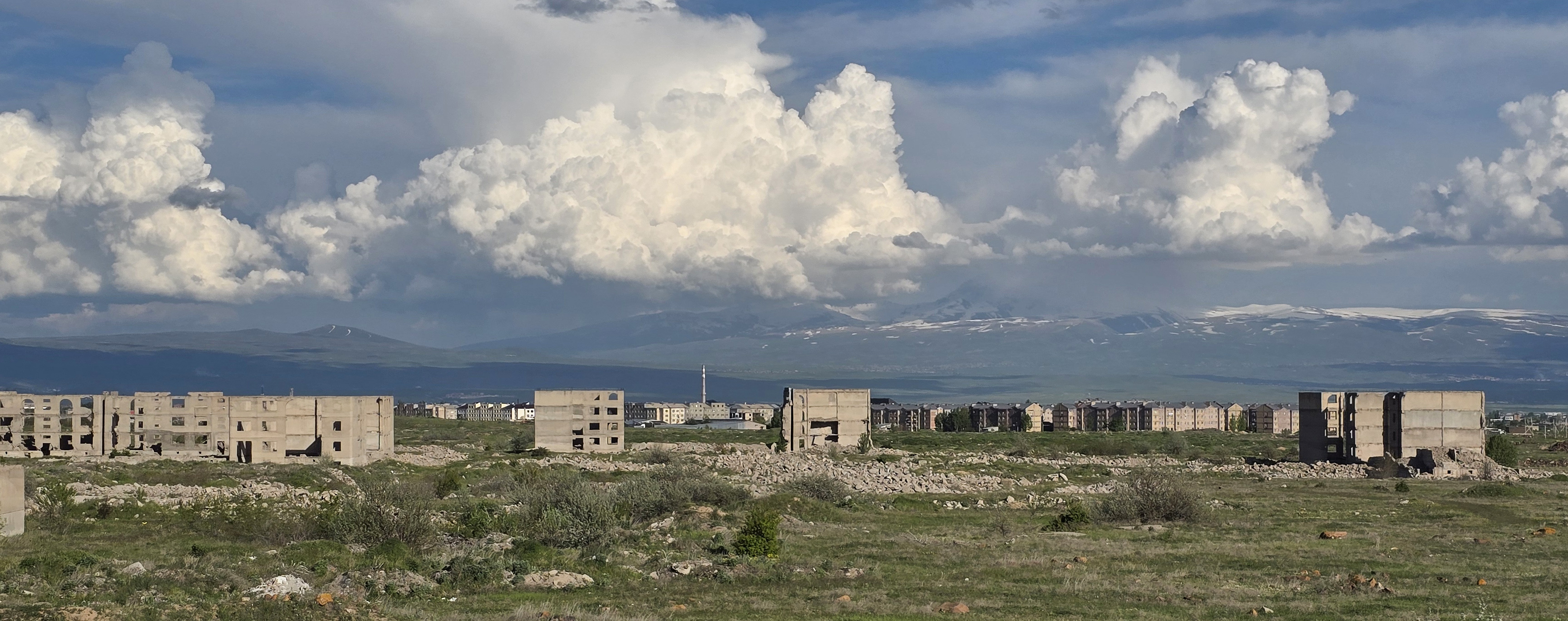
The northwestern outskirts of Gyumri. Disturbed land, abandoned construction sites and unfinished residential development stretch across former agricultural fields.
This landscape emerged from the reconstruction effort that followed the 1988 Spitak earthquake. Faced with the urgent need to provide housing for thousands of displaced residents, Soviet authorities launched an ambitious rebuilding programme and promised a rapid recovery of the city. Construction organisations from across the Soviet Union arrived in Gyumri, while planners designated large areas of agricultural land on the outskirts for new residential districts.
Satellite imagery reveals the scale of this transformation particularly well. Builders levelled fields, excavated large areas and prepared vast tracts of land for urban expansion. The Soviet Union collapsed before many of these projects reached completion, leaving behind neighbourhoods that never fully emerged. Decades later, the landscape still reflects that interrupted transition. Farmers no longer cultivate much of this land, yet the planned urban districts never fully materialised either.
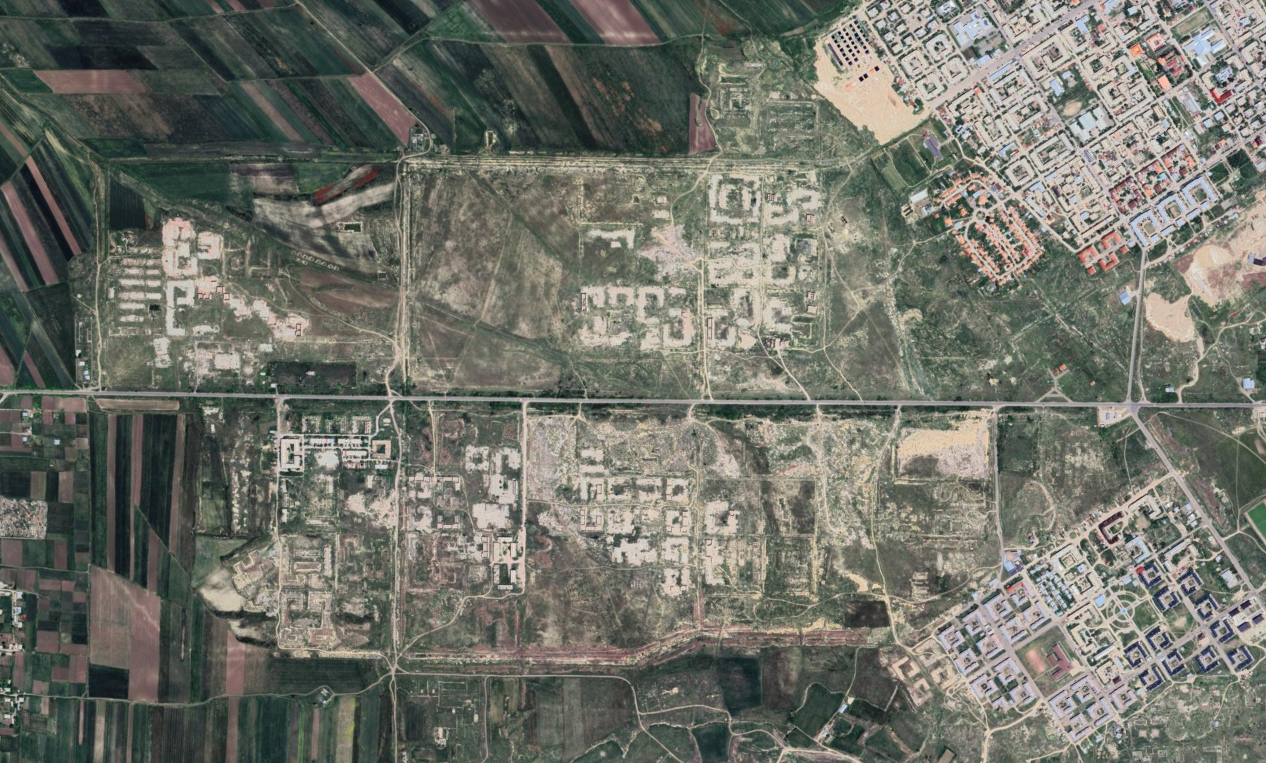
Satellite imagery showing the extent of post-earthquake urban expansion on former agricultural land northwest of Gyumri (Google Earth, 2023).
The collapse of the Soviet Union did not simply halt construction. It marked the beginning of a new phase in the history of these districts. During the following years, people dismantled parts of unfinished buildings and extracted steel reinforcement bars from reinforced concrete structures. Materials that once formed part of an ambitious reconstruction programme acquired a different value as economic resources. At the same time, roads, utility networks and construction sites remained unfinished. Weather, neglect and the absence of maintenance gradually accelerated the deterioration of the remaining structures. Decades later, many of the buildings no longer exist in a state of suspended construction. What once represented unfinished neighbourhoods now forms a landscape where many structures have deteriorated beyond any realistic prospect of completion.
Today, a small number of families continue to live among these remains.
On a recent fieldtrip, we visited a small cluster of apartment buildings within this landscape. Three four-storey blocks stand some distance from the city, surrounded by the remnants of construction that never reached completion. Together, they contain forty-eight apartments, yet fewer than fifteen families still live there. The numbers become visible long before anyone mentions them. Empty windows interrupt occupied facades. Some apartments remain dark and abandoned. Others reveal broken glass, damaged interiors and years of neglect. The buildings feel inhabited and deserted at the same time.
Life continues there, nonetheless. Stacks of firewood line exterior walls and fill parts of nearby unfinished buildings, revealing how residents heat their homes during the long winter months. Inside the apartments, wood-burning stoves remain essential. Residents have also developed their own solutions for water supply and other everyday needs. In buildings where most apartments stand empty, organising collective improvements becomes difficult. Instead, households make adjustments individually, improving and maintaining their apartments as best they can.
The buildings themselves tell part of the story. Builders assembled them from large reinforced-concrete blocks, each roughly the size of a room. Walking through the apartments, residents can still point to joints between these blocks that were never properly sealed. Rainwater continues to find its way through some of these gaps, leaving stains on walls and ceilings and creating problems that residents have learned to live with for decades. The unfinished structures surrounding the apartment blocks tell a similar story. Although planners never completed them, residents gradually incorporated parts of these buildings into everyday life. Ground-floor spaces now serve as garages, storage areas for firewood, workshops and other practical purposes. Thus, these structures have become part of the settlement's informal infrastructure, providing functions that the neighbourhood never officially received.
When we first visited the area a year ago, what stayed with us most was the overwhelming sense of abandonment. Returning this spring, however, something else caught our attention first. Part of the landscape had changed.
Near one of the buildings, a large pit left behind by an unfinished infrastructure project had disappeared. Someone had gradually filled it with construction debris, levelled the ground and incorporated it into the surrounding area. The courtyard itself looked noticeably different. Young trees had grown. Flower beds had appeared. Grass and vegetation no longer seemed to spread unchecked across the site. A playground that had stood there the previous year looked maintained and freshly painted. Trees had been pruned. The entire space appeared more cared for and more actively used.
The contrast with the surrounding landscape was striking.
One resident had carried out much of this work over several years. He arranged for construction companies to bring rubble that could fill abandoned excavations. He planted trees and flowers, maintained the courtyard and gradually improved the space around the building. None of these changes transformed the wider landscape. Yet together they altered the atmosphere of the immediate surroundings in ways that became obvious even over the course of a single year. They show hundreds of small choices and many hours of effort.

Construction debris being used to fill an abandoned excavation beside one of the apartment buildings. Residents have gradually transformed parts of the surrounding landscape through small-scale interventions.
But the longer we stayed, the harder it became to focus only on these improvements.
Just beyond the courtyard, the scene changes again. Trash lies along the paths and open ground. Stray dogs wander between unfinished buildings. Empty structures fill the horizon. Dirt roads link the settlement to the nearest paved road, and when it rains or snows, getting in and out becomes even harder. The area lacks even the most basic infrastructure. There is no grocery store. Instead, an ageing minibus periodically arrives from the city carrying food and household supplies. Residents buy what they need from it, often paying considerably more than they would in town. Children walk to school through this landscape. Informal paths cut across disturbed ground toward a neighbouring district where schools and services remain available. Along the way, they pass abandoned structures, open fields and areas frequented by stray dogs.
Standing in the courtyard, it is easy to see how much difference a few years of dedicated effort can make. Standing outside it, a different question emerges. The transformed space occupies only a small fragment of a much larger territory. Beyond it stretches a landscape shaped by unfinished construction, decades of deterioration and the absence of any coherent strategy for its future. Restoring hundreds of hectares of disturbed land, addressing the remains of abandoned construction projects or creating the infrastructure that never materialised would require resources far beyond the reach of any individual resident or small group of neighbours.
As we left the settlement, we passed once more through the courtyard with its trees, flowers and freshly painted playground. A few minutes later, the dirt road led back into the wider landscape of unfinished buildings, excavated ground and abandoned construction sites stretching toward the horizon. The distance between these two realities is surprisingly small. Yet the gap between the scale of the problems and the scale of the available solutions feels much larger. Perhaps that is what makes this place so memorable. The courtyard demonstrates what people can achieve through persistence, care and long-term commitment. The surrounding landscape reveals a different reality: some transformations demand resources, coordination and capacities that extend far beyond the level of individual effort. Both realities coexist here, side by side, within a landscape shaped by a reconstruction project that never truly reached its conclusion.
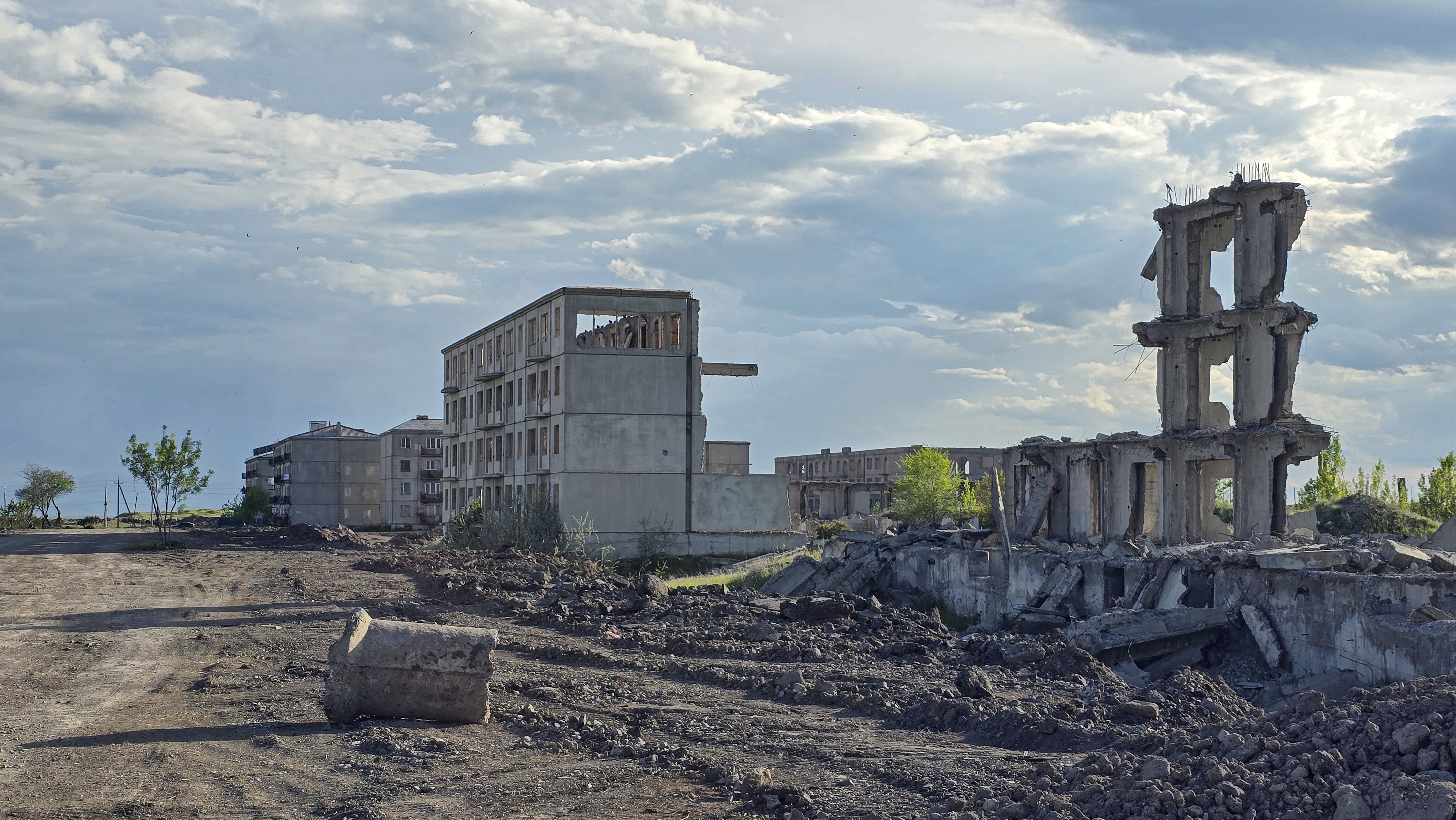 Leaving the settlement. Apartment buildings occupied by a handful of families stand amid the remains of a much larger reconstruction project.